

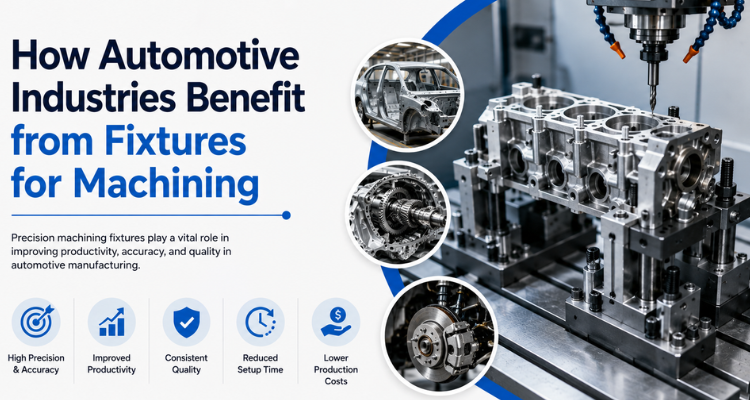
Quality, uniformity, and productivity are crucial in the automotive industry for making high-quality parts. Even the engine blocks and transmission systems are subjected to rigorous quality controls to assure performance and safety. Fixtures for machining are one of the most essential apparatus that can be used to control the level of accuracy.
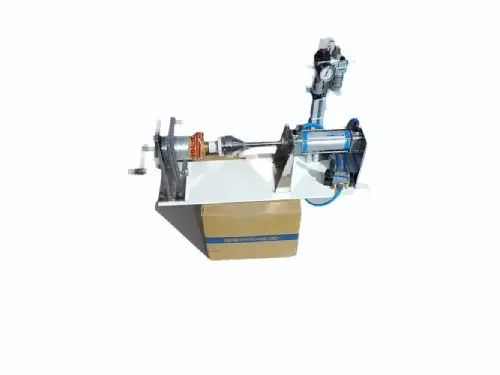
A machining fixture is an important tool to enhance the quality of production and reduce manufacturing errors to a large extent. They are special-purpose machines that are engineered to provide the holding, supporting, positioning of workpieces, particularly during the machining processes. These fixtures have a significant role in modern-day auto manufacturing operations, ensuring that they remain speedy and exact in a large volume production line.
Increased accuracy and precision
A high degree of precision and close tolerances are demanded for automotive components. A small mistake can play a major role in a car’s functionality. The stability of the workpiece during drilling, milling, turning or grinding is achieved by using the help of machining fixtures.
Fixtures prevent unnecessary vibration and movement by securely holding the workpiece in place, so it is held in the proper position. This creates very accurate cuts and uniform quality of production. Precision is used by automotive manufacturers to make identical parts in mass production.
Faster Production Process
The automotive industry places a premium on speed, and it’s crucial to produce car parts quickly while maintaining high quality. Machining fixtures can decrease set up time and increase work flow efficiency.
Parts can be quickly positioned and jammed in place without having to take any additional time to manually align. Very fast and repeatable machining operations due to the fixture setting each component in position. This means automotive industries can achieve productivity gains and minimise manufacturing delays.
Better Product Consistency
One of the largest issues in auto production is consistency. Each part manufactured should be identical to the others in order to facilitate vehicle assembly and provide for the components’ performance.
Machining Fixtures provide uniformity as all workpieces are held in the same position during production. This reduces deviations from part to part and assists in producing a constant quality product during the manufacturing process.
This allows automotive companies to cut their return on equity, boost consumer satisfaction and build a higher brand reputation.
Enhanced Worker Safety
Safety is an important factor in any manufacturing environment. Components that need to be moved by hand when being machined can be a source of workplace accidents and injuries.
Fixtures will improve worker safety by securely clamping the workpiece in place to improve safe working practices. In the machining process, the following work does not need to operate by continuously holding parts, eliminating the possibility of slip, movement and contact with the cutting tool.
An accident and injury free workplace will not only keep employees safe but also make a workspace truly efficient and help minimize down-time attributed to accidents.
Reduced Material Waste
An automotive production process can incur very high costs from materials waste. During the machining process, it is easy to have errors and the result is that the parts have to be discarded.
Wastage is minimised through the use of fixtures to give greater accuracy in machining and lessen the chance of errors. When properly positioned, the cuts are cleaner and the finishing will be better, reducing the likelihood of defective products.
This will save costs and increase profitability with automotive manufacturers by minimizing the amount of material being lost, and the demand for reworking.
Support for Complex Automotive Components.
The biggest amount of advanced and complicated components are fitted in the present vehicles which follow exact machining techniques. Numerous parts have complex designs—like engine heads, brake mechanisms, and transmission casing—and many require a machining angle of more than 90 degrees.
These complex parts are often supported in the manufacturing process with ‘custom fixtures’. They keep accuracy and alignment while performing the machining in multi-angles.
Such flexibility is very useful when manufacturing today’s modern automotive parts by machining fixtures.
Increased Automation Compatibility
The automotive manufacturing sector is undergoing a rapid transformation with automation. Today there are many factories involved in launching the CNC machines along with robotic systems, which enable them to have speed and precision improved.
Machining fixtures can be used in automated production systems as they ensure the accuracy and repeatability of the tool’s position in the machine. Allows the machines to handle operations in a minimal human and device intervention.
Automation-friendly fixture systems lead to automotive manufacturers having more efficiency, lower labour charges and better production scalability.
Cost-Effective Manufacturing Solution
Machining fixtures would give initial investment but would incur development cost, whereas it would save cost over time. When it comes to profitability, the better the efficiency, less the mistakes, the less the waste, the quicker the production, the better the profitability.
In the automotive industry, where production needs are high, fixtures are valuable assets that enhance the efficiency and productivity of the manufacturing processes.
Conclusion
In precision manufacturing and in the field of car manufacturing, machining fixtures are particularly in demand. These tools offer various advantages to automotive manufacturers, such as boosting precision, productivity, worker safety, and minimizing waste.
Improved quality and efficient manufacturing solutions will increasingly be needed as vehicle technology progresses. Even in this era, automotive industries depend on the machining fixtures to keep the quality, consistency and productivity in competitive markets.